

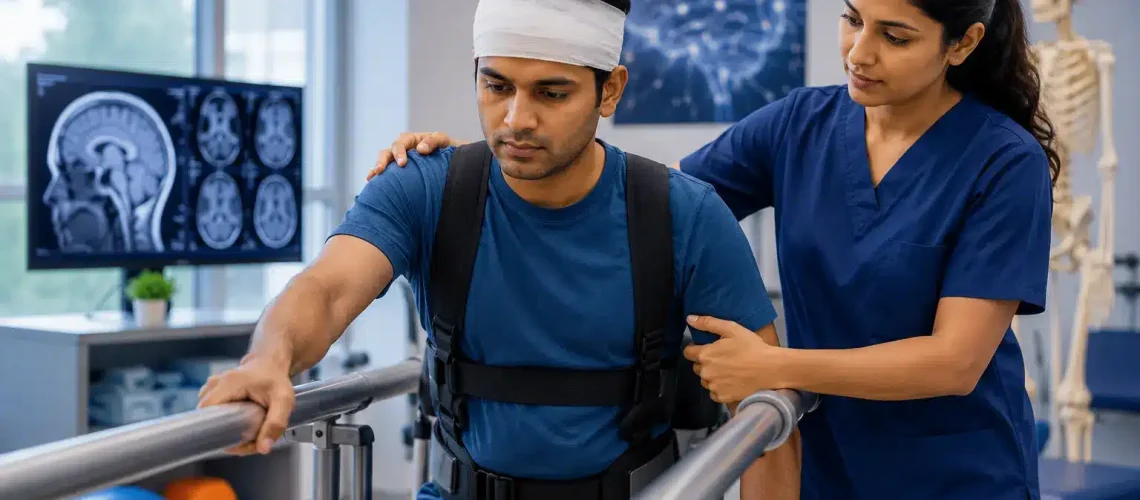
A compassionate, physician-reviewed guide for survivors and families navigating life after TBI — and how expert rehabilitation strategies make the difference.
- Clinically reviewed by - Punarvaas Hospital
Every day across India, families receive a call that changes everything. In a single moment, a road accident becomes a turning point — not just for the person injured, but for everyone who loves them. Traumatic Brain Injury is one of the most devastating consequences of these accidents. Yet with the right rehabilitation strategies and physician-led care, recovery is not just possible — for many, it is remarkable.
What Is Traumatic Brain Injury (TBI)?
Traumatic Brain Injury (TBI) occurs when an external force — such as a collision, a sudden jolt, or impact with the road — damages the brain. In road accidents, this results from direct impact, the shockwave of a high-speed crash, or rapid acceleration-deceleration forces that cause the brain to strike the inside of the skull. TBI is not a single diagnosis; it exists on a spectrum of severity, classified using the Glasgow Coma Scale (GCS).
Mild TBI
GCS 13–15
- Confusion, headaches, dizziness, memory gaps
- Brief or no loss of consciousness
- Most resolve with rest
- Some develop Post-Concussion Syndrome
Moderate TBI
GCS 9–12
- Loss of consciousness up to 24 hours
- Memory loss up to 1 week
- Requires hospitalisation and structured rehabilitation
Severe TBI
GCS ≤ 8
- Coma or prolonged unconsciousness
- Life-threatening; may require surgery
- ICU care essential
- Long-term intensive rehabilitation required
TBI & Road Accidents in India: The Scale of the Problem
India has one of the highest rates of road traffic accidents in the world. Approximately 1 million people sustain brain injuries every year in India, with around 200,000 deaths and an equal number requiring dedicated rehabilitation services. Two-wheeler accidents account for 50% of all TBI cases, with the average patient being just 36.9 years old — breadwinners, parents, and students at the prime of their lives.
Symptoms Families Should Not Ignore
TBI symptoms are not always immediate. Effects can surface hours, days, or even weeks after the accident — and delayed symptoms are the most frequently missed.
⚠ Immediate Symptoms
- Loss of consciousness
- Confusion or disorientation
- Repeated vomiting
- Severe or worsening headache
- Unequal pupil sizes
- Seizures or slurred speech
- Weakness in limbs
🔔 Delayed Symptoms
- Persistent memory difficulties
- Personality or mood changes
- Depression or anxiety
- Difficulty concentrating
- Balance or coordination issues
- Sleep disturbances
- Sensory processing changes
IMPORTANT: Seek emergency care immediately if any immediate symptoms are present. Do not wait to see if they resolve. Delayed treatment significantly worsens outcomes in moderate and severe TBI.
Understanding the TBI Recovery Journey
Recovery from TBI is rarely linear. The Rancho Los Amigos (RLA) Scale is a 10-level framework used internationally to help families and clinicians understand where a patient is in their recovery — and what to expect next. Rehabilitation strategies are tailored to each level.
| Level | Stage | Description | Rehabilitation Focus |
|---|---|---|---|
| 1–2 | No / Generalised Response | The patient is unresponsive or in a coma. No purposeful movement. | Medical stabilisation, complication prevention, sensory stimulation |
| 3–4 | Localised / Confused-Agitated | Begins reacting to stimulation; restless, agitated, confused. | Agitation management, structured sensory stimulation, family education |
| 5–6 | Confused-Inappropriate / Appropriate | Short attention, poor memory, and impulsivity. Beginning to follow commands. | Cognitive retraining, safety training, structured daily routines |
| 7–8 | Automatic / Purposeful-Appropriate | Routine tasks improving; limited self-awareness. | Community reintegration, vocational planning, independent living |
| 9–10 | Reintegration / Independence | Near or fully independent; minor deficits may remain. | Sustained quality of life, return to work/family, long-term follow-up |
Rehabilitation Physician-Led Care
At the heart of TBI rehabilitation is the Rehabilitation Physician (Physiatrist) — a specialist trained to manage the complex medical sequelae of brain injury while simultaneously orchestrating recovery across every domain of function. Before any rehabilitation strategy can progress, the physician must establish medical stability. Below are the critical post-traumatic brain injury sequelae that the rehabilitation team actively monitors and manages.
1.Post-Traumatic Agitation
Post-traumatic Agitation (PTA) is one of the most challenging behavioural manifestations of TBI, typically emerging as the patient transitions out of coma. It is characterised by restlessness, physical aggression, verbal outbursts, disinhibition, and confusion.
Medical Management includes:
- Environmental modifications: Reduced sensory stimulation, consistent caregivers, predictable routines, minimising unnecessary procedures
- Pharmacological interventions: Amantadine (first-line), beta-blockers (propranolol), mood stabilisers (valproate), atypical antipsychotics used with caution
- Avoidance of sedating agents that impair neurological recovery (e.g., haloperidol used sparingly)
- Structured behavioural programs to de-escalate and redirect rather than restrain
2.Disorder of Consciousness (DoC)
Disorders of consciousness exist on a continuum: Coma (no arousal, no awareness), Vegetative State / Unresponsive Wakefulness Syndrome (UWS) (arousal present, no awareness), and Minimally Conscious State (MCS) (fluctuating but reproducible signs of awareness).
Medical Management includes:
- Standardised assessment tools: Coma Recovery Scale-Revised (CRS-R), SMART — repeated over time as DoC can evolve
- Pharmacological trials: Amantadine (shown to accelerate recovery per Giacino et al.), zolpidem, levodopa
- Sensory stimulation programs: multimodal stimulation across auditory, visual, tactile, olfactory, and kinaesthetic channels
- Optimisation of secondary factors suppressing consciousness: pain, seizures, metabolic imbalances, sleep-wake cycle
- Family guidance on prognosis and distinction between reflexive and purposeful responses
3.Spasticity
Spasticity — a velocity-dependent increase in muscle tone due to disruption of upper motor neuron pathways — develops in a significant proportion of moderate-to-severe TBI survivors. If unmanaged, it leads to pain, contractures, pressure injuries, and barriers to rehabilitation progress.
Medical Management includes:
- Physiotherapy: passive range-of-motion, splinting, serial casting, positioning to prevent contractures
- Oral antispasmodics: Baclofen, tizanidine, dantrolene — carefully chosen to avoid sedation impairing cognitive recovery
- Botulinum toxin (Botox) injections: Targeted focal spasticity management (hip adductors, wrist flexors) to improve function
- Intrathecal baclofen (ITB) pump: For severe, generalised spasticity refractory to oral medications
- Regular assessment using Modified Ashworth Scale (MAS) and Tardieu Scale
4.Dysautonomia (Paroxysmal Sympathetic Hyperactivity)
Paroxysmal Sympathetic Hyperactivity (PSH) — or sympathetic storming — occurs in up to 15–33% of patients with severe TBI. It produces episodes of tachycardia, hypertension, hyperthermia, tachypnoea, diaphoresis, and posturing due to loss of cortical inhibition over sympathetic pathways.
Medical Management includes:
- Identification and removal of triggers: pain, urinary retention, pressure injuries, excessive stimulation, constipation
- Pharmacological suppression:
- Propranolol — beta-blocker, reduces heart rate and sympathetic tone
- Clonidine — central alpha-2 agonist, reduces sympathetic outflow
- Bromocriptine — dopamine agonist, also aids consciousness recovery
- Opioids (morphine) — short-term management during acute storming
- Gabapentin / pregabalin — for sustained neurological stabilisation
- Nutritional support: PSH increases metabolic demands significantly
- Temperature regulation: active cooling during hyperthermia episodes
5.Electrolyte Dysfunction
Electrolyte imbalances are common in TBI and directly impair neurological recovery, cognition, and consciousness. The most clinically significant involve disorders of sodium regulation requiring careful correction.
Key Conditions & Management:
- Hyponatraemia: Most common; causes include SIADH, cerebral salt wasting, excessive free water. Managed with fluid restriction, demeclocycline, or vasopressin antagonists. Rapid correction must be avoided (osmotic demyelination risk).
- Hypernatraemia: Often from central Diabetes Insipidus (DI); managed with Desmopressin (DDAVP) and free water supplementation.
- Hypokalaemia / hyperkalaemia: Close monitoring required, especially with diuretics or tube feeds.
- Hypocalcaemia and hypomagnesaemia: Worsen seizure threshold; corrected through supplementation with regular biochemical review.
6.Infections
TBI patients — particularly those in prolonged DoC, on ventilatory support, or with urinary catheters — are highly vulnerable to Healthcare-Associated Infections (HAIs), which delay recovery, worsen outcomes, and increase mortality.
Common Infections & Management:
- Hospital-Acquired / Ventilator-Associated Pneumonia (HAP/VAP): Culture-guided antibiotics; head-of-bed elevation, oral hygiene, early ventilator weaning.
- Urinary Tract Infections (UTI): Catheter-associated UTIs managed with timely changes and targeted antibiotics; intermittent catheterisation preferred.
- Surgical site / wound infections: Post-craniotomy wound monitoring, aseptic technique, early identification of CSF leak.
- Pressure injury-related infections: Prevention through repositioning, pressure-relieving surfaces, and nutritional optimisation.
- Antimicrobial stewardship: Regular review of CRP, procalcitonin, WBC; avoid unnecessary broad-spectrum antibiotics.
7.Tube Management & Weaning
Many moderate-to-severe TBI patients arrive in rehabilitation with a tracheostomy and/or Nasogastric (NG) or Percutaneous Endoscopic Gastrostomy (PEG) tube. Safe, stepwise weaning from these tubes is a core goal of rehabilitation physician-led care.
Tracheostomy Management & Decannulation:
- Assessment of respiratory drive, secretion management ability, and upper airway patency before weaning
- Progressive speaking valve (Passy-Muir) trials to restore voice, improve swallowing, facilitate communication
- Downsizing tracheostomy tube followed by capping trials under monitored conditions
- Decannulation when patient demonstrates adequate respiratory effort, effective cough, secretion control, and safe swallow function
Nutritional Tube Weaning (NG / PEG):
- Speech-Language Pathologist (SLP)-led assessment: Clinical evaluation + Modified Barium Swallow Study (MBSS) or FEES where indicated
- Modified food/fluid textures (IDDSI framework), compensatory swallowing techniques, swallowing exercises
- Transition from NG to PEG tube for patients requiring prolonged enteral nutrition (>4–6 weeks)
- Monitoring nutritional parameters (weight, albumin, prealbumin) throughout the weaning process
Rehabilitation Strategies That Drive Recovery
TBI rehabilitation is a coordinated, multidisciplinary process that addresses the full spectrum of consequences — physical, cognitive, communicative, and emotional. At Punarvaas, our team designs rehabilitation strategies around each patient’s individual needs, injury profile, and life goals.
🦾
Physiotherapy
Restores strength, balance, coordination, and gait through progressive mobilisation strategies. Helps patients move from bed to sitting, standing, and walking — one milestone at a time.
🏡
Occupational Therapy
Rebuilds independence in daily living — dressing, bathing, cooking, self-care. Trains families in adaptive techniques and prepares the home for a safe return.
🗣️
Speech & Language Therapy
Addresses aphasia, communication barriers, and swallowing disorders (dysphagia). Includes Augmentative and Alternative Communication (AAC) strategies for non-verbal patients.
👨👩👧
Caregiver Training
🧠
Cognitive Rehabilitation
💙
Neuropsychological Support
How Punarvaas Supports TBI Recovery
Punarvaas is a dedicated neurorehabilitation center in Bangalore, built specifically for patients recovering from neurological conditions including Traumatic Brain Injury. After the acute hospital phase, the real work of recovery begins — and we are here for every stage of it.
🩺 Physician-Led Medical Care
Rehabilitation physicians manage complex post-TBI sequelae alongside the multidisciplinary team, ensuring medical stability never delays rehabilitation progress.
🌐 Multidisciplinary Excellence
Physiotherapy, OT, speech therapy, cognitive rehab, and neuropsychology working in daily coordination around each patient’s individual goals.
❤️ Human-Centered Care
🤝 Family Partnership
We train and empower families throughout rehabilitation, because a well-supported family is one of the strongest predictors of patient success in India’s context.
Frequently Asked Questions (FAQ)
How long does TBI recovery take after a road accident in India?
Can a person fully recover from a severe brain injury?
When should TBI rehabilitation begin?
As soon as the patient is medically stable — sometimes even within the ICU with passive range of motion and sensory stimulation. Research is clear: early rehabilitation produces significantly better outcomes. If your loved one was discharged without a plan, contact Punarvaas immediately.
What is post-traumatic agitation and how is it managed?
Post-traumatic agitation is a common behavioural manifestation during early TBI recovery — marked by restlessness, aggression, confusion, and disinhibition. It is managed through environmental modifications, behavioural strategies, and pharmacological interventions such as amantadine or beta-blockers under physician supervision.
What is a disorder of consciousness after TBI?
Is TBI rehabilitation covered by insurance in India?
Coverage varies by insurer and policy. Most policies cover the acute hospital phase. Rehabilitation coverage is improving but remains inconsistent. Our team at Punarvaas can assist with documentation to support your insurance claim.
What is the difference between a neurologist and a neurorehabilitation specialist?
A neurologist diagnoses and manages neurological conditions medically. A rehabilitation physician (physiatrist) specialises in restoring function and quality of life, leading a multidisciplinary team. In the post-acute phase of TBI recovery, the rehabilitation physician leads care.
Recovery Begins with One Step
Early, physician-led rehabilitation makes a measurable difference. If your loved one has suffered a TBI following a road accident, do not wait — reach out to our specialist team today.
- Physician-led care
- Multidisciplinary team
- Family-centred approach
- Bangalore, India
Punarvaas Hospital — Best Neurorehabilitation Centre, Bangalore, Karnataka, India
Note: This article is for educational purposes only and does not constitute medical advice. Consult a qualified rehabilitation physician for diagnosis and treatment.
