

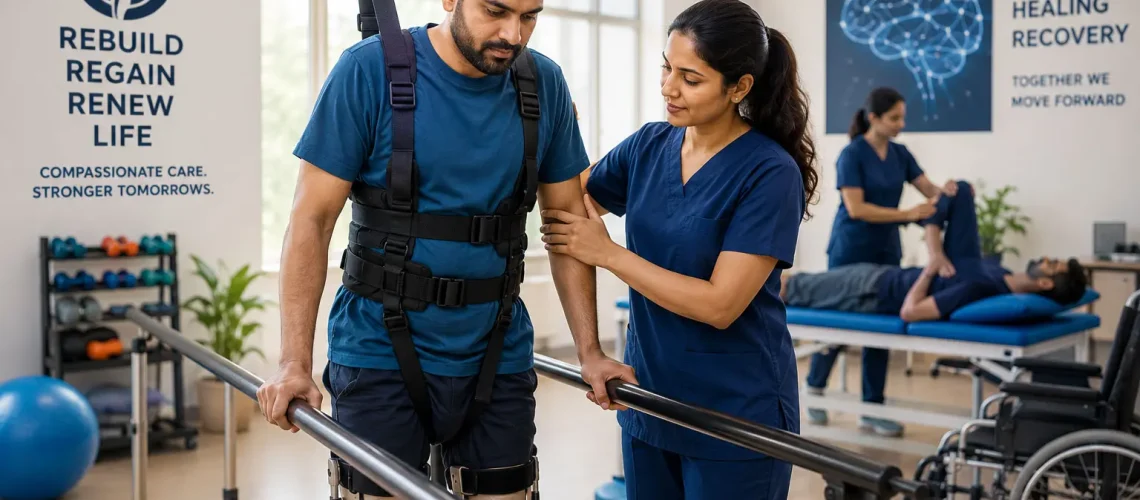
Medically informed guide by “Punarvaas Hospital” Bangalore’s most advanced rehabilitation hospital. Renewing Hope, Restoring Lives.
Rehabilitation for a patient with paralysis is a structured, physician-led recovery program that helps a person regain movement, independence and quality of life after losing muscle function. It combines physiotherapy, occupational therapy, speech therapy, and advanced neuro-technology to retrain the brain and body.
While not every paralysis is fully reversible, early and intensive rehabilitation can significantly improve mobility, independence and quality of life, particularly during the first 3 to 12 months after injury or illness.
If a loved one has just experienced a stroke, spinal cord injury or neurological event, the days that follow are overwhelming. This guide explains the types of paralysis, the treatments that actually work, realistic recovery timelines, and most importantly what families in Bangalore must know to make the right decisions early.
What Is Paralysis?
Paralysis is the loss of the ability to move one or more muscles, usually caused by damage to the nervous system the brain, spinal cord or nerves rather than to the muscles themselves. It may be complete (no movement) or partial/incomplete (some movement or sensation remains), and either temporary or permanent depending on the cause and how quickly treatment begins.
Common Causes of Paralysis
Common causes include stroke, spinal cord injury, traumatic brain injury, multiple sclerosis, Guillain-Barré Syndrome, cerebral palsy and certain infections or tumours. Identifying the cause is the first step, because it shapes the entire rehabilitation plan.
Types of Paralysis
Doctors classify paralysis by where in the body it occurs and how much function is lost. Understanding the type helps families know what to expect from rehabilitation.
- Monoplegia – paralysis of a single limb, such as one arm or one leg.
- Hemiplegia – paralysis of one side of the body (arm and leg on the same side), most often caused by a stroke or brain injury.
- Paraplegia – paralysis of both legs and sometimes the lower trunk, usually from a spinal cord injury in the mid-to-lower back.
- Quadriplegia (tetraplegia) – paralysis of all four limbs and the trunk, caused by injury to the upper (cervical) spinal cord.
Paralysis is also described as flaccid (muscles become loose and limp) or spastic (muscles become tight, stiff and prone to spasms). Spasticity is common after stroke and spinal injury and needs dedicated management something a specialist rehabilitation hospital handles far better than general care.
Paralysis Treatment & Rehabilitation Options
There is no single “paralysis cure,” but a well-designed rehabilitation program can restore meaningful function and independence. The most effective programs are physician-led and multidisciplinary, meaning a rehabilitation physician coordinates a full team rather than the patient seeing isolated therapists. Here are the core pillars of modern paralysis treatment.
1. Physical Therapy (Physiotherapy)
2. Occupational Therapy
3. Speech and Swallow Therapy
4. Advanced Neuro-Technology
5. Spasticity & Pain Management
How Neuroplasticity Drives Recovery
Signs That Professional Rehabilitation Is Needed
- Difficulty walking or standing independently
- Weakness on one side of the body
- Loss of balance and coordination
- Difficulty speaking or swallowing
- Frequent falls
- Dependence on family members for daily activities
- Muscle stiffness or spasms
Paralysis Realistic Recovery Timeline
Recovery varies with the cause, severity and how soon rehabilitation starts, but general patterns help families set expectations:
- First 03 months: The most rapid gains, particularly after stroke. Intensive rehabilitation during this window is critical.
- 3 – 12 months: Continued, steady improvement in strength, mobility and independence.
- Beyond 12 months: Progress is often slower but still possible many patients keep improving for years with consistent therapy, especially incomplete injuries.
Two patients with the same diagnosis can recover very differently. What you can control is starting early, choosing specialist care, and staying consistent.
What Families Must Know About Paralysis Recovery
Family members are not just visitors you are part of the recovery team. Here is what matters most.
- Start rehabilitation as early as it is medically safe. The early window is precious. Delays can mean lost function.
- Choose a dedicated rehabilitation hospital, not just a general ward. Physician-led, multidisciplinary care with advanced technology produces better outcomes than fragmented therapy.
- Prevent secondary complications. Pressure sores, contractures, blood clots, infections and depression can derail recovery. A specialist team actively prevents these.
- Support emotional wellbeing. Anxiety and depression are common after paralysis. Encouragement, counselling and small celebrated milestones genuinely speed recovery.
- Learn the home routine. Ask the team to train you on safe transfers, exercises and assistive devices so progress continues at home.
- Be patient and consistent. Recovery is a marathon. Consistency beats intensity that burns out.
