
By Dr. Srikant Venkatakrishnan, Consultant Physical Medicine & Rehabilitation, Punarvaas Hospital | Last medically reviewed: 2 July 2026
Quick answer: Hand function recovery after a stroke depends on six interacting factors — the location and size of the brain lesion, coexisting health conditions, time since the stroke, the intensity of therapy, the type and variety of therapy used, and how well complications like spasticity and pain are managed. Recovery is not limited to the first six months; with the right, sufficiently intense, and correctly targeted rehabilitation, meaningful gains in hand use are possible months to years after a stroke.
Key Takeaways
- Lesions in grey matter generally carry a more favourable prognosis than white matter lesions, because grey matter houses neuron cell bodies while white matter carries the “wiring” to the spinal cord and muscles.
- Diabetes, hypertension, frailty, and depression can slow recovery — controlling these conditions is part of optimising hand recovery, not separate from it.
- Recovery is fastest in the first 0–6 months post-stroke but does not stop there; later-phase, targeted therapy can still produce real functional gains.
- More repetitions of the correct exercise, delivered consistently, are linked to better outcomes — therapy intensity matters.
- Task-oriented, varied therapy (reaching, grasping, bimanual tasks) combined with adjuncts like functional electrical stimulation (FES), mirror therapy, and constraint-induced movement therapy (CIMT) produces greater gains than any single technique alone.
- Spasticity and pain are treated in a stepwise fashion — splinting, oral medication, botulinum toxin injections, chemical neurolysis, and in select chronic cases, tendon transfer surgery.
- Recovery has two dimensions — neurological (the hand regaining movement) and functional (the ability to perform daily activities) — and both need to be addressed together.
- Best outcomes come from a coordinated team: PM&R physicians, physiotherapists, occupational therapists, orthotists, and social workers working toward one plan.
What determines hand function recovery after a stroke?
1. Location and size of the brain lesion
2. Comorbidities: the conditions recovery is competing with
3. Time since the stroke: recovery is fastest early, but it doesn’t stop
4. Intensity of therapy
Evidence consistently points to a simple but demanding principle: more repetitions of the right kind of exercise lead to greater functional recovery. Rehabilitation guidelines from groups including the U.S. Department of Veterans Affairs/Department of Defense and the European Stroke Organisation have specifically highlighted therapeutic intensity as a factor that should be increased wherever feasible for upper-limb recovery. This is one reason in-patient, physician-led rehabilitation settings — where therapy dose can be closely supervised and progressively increased — often produce better hand outcomes than sporadic outpatient sessions alone.
5. Type of therapy: it has to be customised and task-oriented
There is no single exercise that restores hand function. Effective therapy is customised and task-oriented, and typically needs to include a variety of approaches working together:
- Tone normalisation and joint flexibility work
- Sensory integration training
- Facilitation of motor control
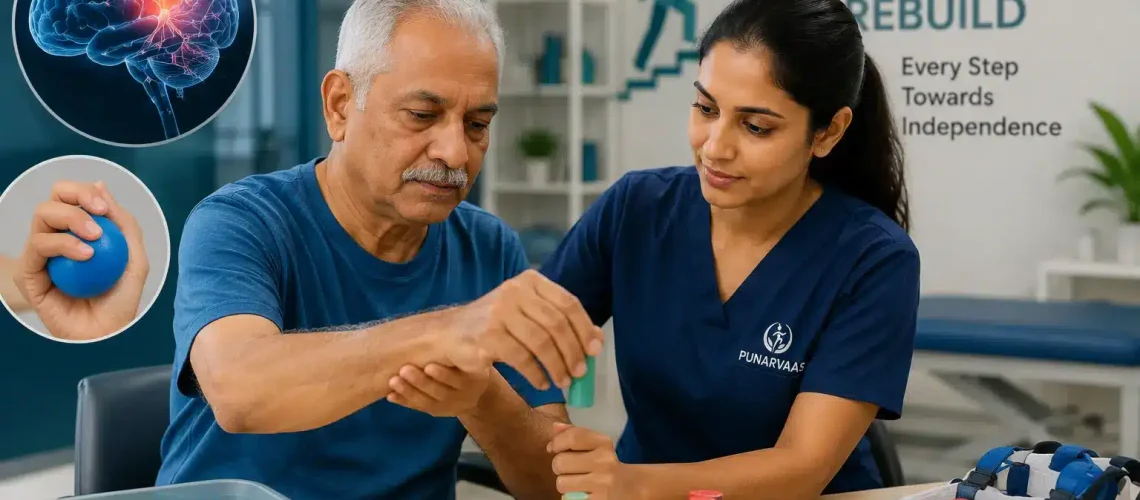
- Functional activities such as reaching, grasping, and bimanual (two-handed) tasks
Adding functional electrical stimulation (FES), mirror therapy, and constraint-induced movement therapy (CIMT) on top of conventional therapy has been shown to produce greater gains than conventional therapy alone — see the Cochrane review on constraint-induced movement therapy. Training for self-care and activities of daily living (ADLs) — dressing, grooming, bathing, including single-limb adaptive techniques — is equally essential so patients can function as independently as possible even while neurological recovery continues.
Newer and adjunctive techniques — robotic hand rehabilitation, repetitive transcranial magnetic stimulation (rTMS), vagal nerve stimulation, and hyperbaric oxygen therapy — have also shown evidence of improving hand function in appropriately selected patients, generally as an addition to, not a replacement for, conventional therapy.
6. Targeted interventions for pain and spasticity
Pain and spasticity are two of the most common complications that can stall hand recovery if left unaddressed. Spasticity is typically managed through a sequential, stepwise approach:
- Splinting
- Oral medications (baclofen, tizanidine, tolperisone)
- Botulinum toxin injections
- Chemical neurolysis of motor points
- Newer techniques such as cryoablation
In select chronic cases where issues like limited wrist extension or grasp persist despite these measures, tendon transfer surgery may be considered to restore functional positioning and use of the hand.
Neurological recovery vs. functional recovery: two different goals
It’s worth separating two related but distinct ideas that often get blurred:
- Neurological recovery refers to the extent to which the hand itself regains movement — strength, control, coordination.
- Functional recovery refers to the ability to actually use that movement to perform activities of daily living — feeding, dressing, writing, grooming.
Techniques aimed primarily at neurological recovery include rTMS, pulsed electromagnetic field therapy (PEMF), FES, brain-machine interfaces, hyperbaric oxygen therapy, and conventional therapy that promotes relearning and neuroplasticity. Functional recovery is driven by standard-of-care therapy approaches — physiotherapy and occupational therapy focused directly on rebuilding the ability to perform daily tasks.
Both dimensions matter, and neither replaces the other. A hand that regains some movement but is never trained for functional use, or a patient who learns compensatory strategies without any attempt at true neurological recovery, both represent incomplete rehabilitation. The relative value of newer, higher-cost techniques should always be weighed against their functional benefit and cost-effectiveness for the individual patient.
Why community and family reintegration matter
Why hand rehabilitation after stroke needs a multidisciplinary team
Hand rehabilitation after stroke is inherently multifaceted. Meaningful, cost-effective outcomes depend on a team that includes:
- PM&R (rehabilitation medicine) physicians to lead the overall recovery plan and manage medical complexity
- Physiotherapists for motor control, strength, and mobility
- Occupational therapists for fine motor skills, sensory integration, and ADL training
- Orthotists for splinting and positioning devices
- Social workers for family support and community reintegration
Choosing a rehabilitation service that integrates all of these disciplines under one coordinated plan — rather than fragmented, siloed appointments — is one of the clearest ways to optimise both neurological and functional hand outcomes, whether care is delivered through in-patient or out-patient rehabilitation.
Frequently Asked Questions (FAQ)
Can hand function still improve after 6 months post-stroke?
What factors most affect how well a stroke patient recovers hand movement?
Why does the location of a stroke matter more than just its size?
How is spasticity treated after a stroke?
What is the difference between neurological and functional recovery after stroke?
Which therapies help the most with hand recovery after stroke?
Who should be involved in a stroke hand rehabilitation team?
Where can I get physician-led stroke hand rehabilitation in Bangalore?
Recovering hand function after stroke: the Punarvaas approach
At Punarvaas Hospital, South Bangalore’s physician-led rehabilitation centre, stroke recovery is managed by a coordinated team — PM&R physicians, physiotherapists, occupational therapists, and support staff — using a combination of conventional therapy, spasticity management interventions, robotic rehabilitation, virtual reality therapy, and hyperbaric oxygen therapy, tailored to each patient’s lesion, stage of recovery, and goals.
