

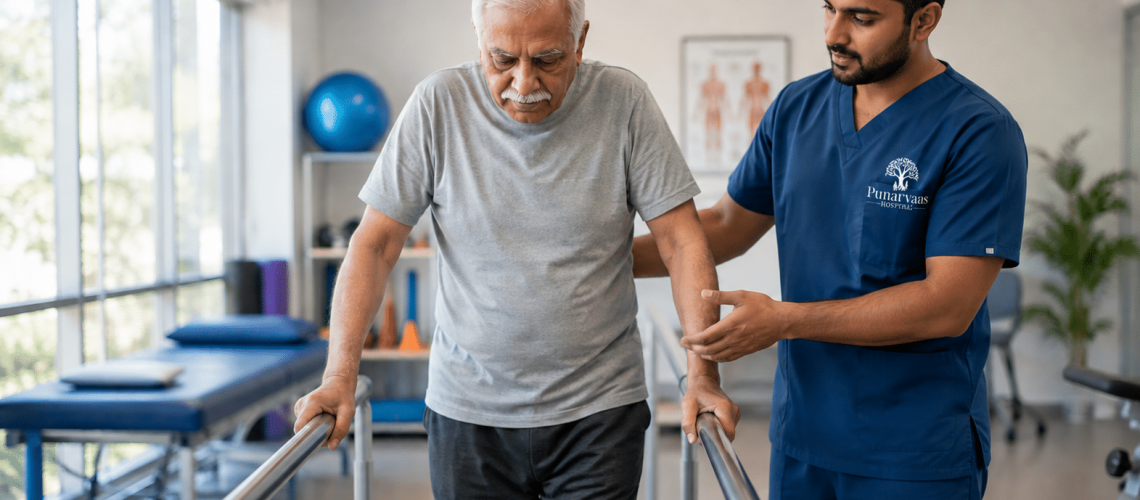
Introduction
Parkinson’s disease can affect movement in different ways. While tremor is one of the symptoms commonly associated with Parkinson’s, some people may also experience stiffness, slower movements, changes in walking, difficulty turning and balance problems.
These changes can affect everyday activities such as walking around the home, getting up from a chair, turning, using stairs or moving safely in different environments.
Balance and mobility difficulties can also change over time. Understanding these changes and seeking appropriate medical and rehabilitation assessment can help families understand what support may be appropriate.
This article explains the relationship between Parkinson’s disease, balance and mobility, and the role of PMR Physician (Physiatrist)-led rehabilitation in addressing individual functional needs.
Table of Contents
- What Is Parkinson’s Disease?
- How Can Parkinson’s Affect Movement?
- Why Can Balance Become Difficult?
- Common Walking and Mobility Changes
- Parkinson’s and Risk of Falls
- When Should a Person Seek Assessment?
- PMR Physician (Physiatrist)-Led Rehabilitation
- Role of Rehabilitation Professionals
- Balance and Mobility Training
- Making the Home Environment Safer
- How Families Can Support a Person With Parkinson’s
- Frequently Asked Questions
- Parkinson’s Rehabilitation at Punarvaas Hospital, Bangalore
- Conclusion
What Is Parkinson’s Disease?
Parkinson’s disease is a neurological condition that can affect movement and other aspects of function.
Movement-related symptoms can include:
- Tremor
- Slowness of movement
- Muscle stiffness
- Changes in walking
- Balance difficulties
Not everyone experiences the same symptoms, and the severity and combination of symptoms can vary between individuals.
Parkinson’s can also affect aspects of speech, swallowing, sleep, cognition and everyday activities in some people.
How Can Parkinson’s Affect Movement?
Movement changes associated with Parkinson’s may develop gradually.
A person may notice:
Slower Movement
Everyday movements may take longer than before, including getting up from a chair, dressing or walking.
Muscle Stiffness
Stiffness may make certain movements more difficult or uncomfortable.
Changes in Walking
Walking may become slower, steps may become shorter, or the person’s usual walking pattern may change.
Reduced Arm Movement
Some people may show reduced arm swing while walking.
Difficulty Turning
Changing direction, turning around or moving through narrow spaces can sometimes become challenging.
Why Can Balance Become Difficult?
Balance depends on the coordinated functioning of several systems, including movement, sensory information, vision and the brain’s ability to respond to changes in the environment.
Parkinson’s-related movement changes can affect how a person controls their posture and responds while standing or moving.
Balance difficulties may become more noticeable during activities such as:
- Turning
- Starting or stopping while walking
- Changing direction
- Walking through crowded areas
- Moving over different surfaces
- Getting up from a chair
- Using stairs
The specific difficulties vary from person to person.
Common Walking and Mobility Changes
Some people living with Parkinson’s may experience changes such as:
Shorter Steps
Steps may gradually become smaller.
Slower Walking
Walking speed may reduce as movement becomes slower.
Some patients also experience a phenomenon called freezing of gait. Patients might be unable to step forward, particularly while starting to walk or turning.
Turning Difficulties
Turning in bed, turning while walking or changing direction may become challenging.
These symptoms should be discussed with the treating medical team so that appropriate assessment can be considered.
Parkinson’s and Risk of Falls
Balance and walking changes may increase the risk of falls in some people with Parkinson’s.
Falls can have consequences beyond the immediate injury. Fear of falling may also lead some individuals to reduce their activities, which can affect participation in everyday life.
Risk can be influenced by several factors, including:
- Balance changes
- Walking difficulties
- Medication-related changes
- Environmental hazards
- Previous falls
- Changes in vision
- Other medical conditions
A proper assessment is important rather than assuming that every person with Parkinson’s has the same fall risk.
There are scales called Fall risk assessment and Berg Bapance test which can help to quantify the risk and address them with appropriate therapies.
When Should a Person Seek Assessment?
Consider discussing an assessment with a qualified medical professional when there are persistent or increasing changes such as:
- Frequent loss of balance
- Repeated falls
- Increasing difficulty walking
- Difficulty turning
- Difficulty getting up from a chair
- New difficulty with everyday activities
- Reduced confidence during walking
An assessment can help identify the person’s specific functional difficulties and determine whether rehabilitation or other interventions may be appropriate.
PMR Physician (Physiatrist)-Led Rehabilitation
Rehabilitation for a person with Parkinson’s should begin with an assessment of the individual’s medical condition, functional abilities and rehabilitation needs.
A PMR Physician (Physiatrist) can evaluate functional limitations and coordinate an individualized rehabilitation plan.
Depending on the person’s needs, rehabilitation may address:
- Mobility
- Balance
- Walking
- Transfers
- Daily activities
- Communication
- Swallowing
- Home safety
- Assistive equipment
The rehabilitation plan can be reviewed and adjusted as the person’s needs change.
Role of Rehabilitation Professionals
A multidisciplinary rehabilitation team may include different professionals depending on the individual’s needs.
Neurologist
Makes the medical diagnosis and adjusts medications based on the disease pattern, and gives the patient a long term management plan.
PMR physician
Identifies functional impairments, sets goals for management of physical symptoms , addresses issues like pain and tightness, leads the multidisciplinary team in the comprehensive management of the patient.
Physiotherapists
They focus on movement, balance, strength, walking and functional mobility.
Occupational Therapists
They focus on everyday activities, hand function and dexterity, handwriting, grip strength and grip improvement, task performance, home safety and appropriate adaptations.
Speech & Language Therapist
Their intervention would be considered when Parkinson’s affects communication or swallowing.
Rehabilitation Nursing and Other Support
Depending on the person’s needs, nursing, psychological, nutritional or other rehabilitation support may also be included.
Balance and Mobility Training
Rehabilitation programs may include activities designed around an individual’s specific functional difficulties.
Examples may include:
- Balance activities
- Walking and gait training
- Turning practice
- Transfer training
- Strength and mobility exercises
- Task-specific activities
The exercises and level of difficulty should be selected according to the individual’s assessment, abilities and safety.
Exercises shown online should not automatically be assumed to be appropriate for every person with Parkinson’s.
Making the Home Environment Safer
Simple environmental changes may help reduce avoidable hazards.
Families can consider:
- Keeping walking areas clear
- Improving lighting in commonly used areas
- Removing loose rugs
- Keeping frequently used items within easy reach
- Using appropriate bathroom safety equipment (such as a toilet seat raise, health faucets, grab bars) where recommended
- Keeping pathways between rooms clear
An Occupational Therapist can assess the person’s daily activities and home environment and suggest appropriate modifications based on individual needs.
How Families Can Support a Person With Parkinson’s
Family support can be an important part of rehabilitation.
Rather than doing everything for the person, families can encourage safe participation in appropriate everyday activities.
Helpful approaches may include:
- Allowing adequate time for activities
- Keeping frequently used items accessible
- Following the rehabilitation team’s recommendations
- Encouraging safe physical activity as advised
- Communicating new difficulties to the treating team
- Supporting attendance and participation in recommended rehabilitation
The level of assistance should match the person’s abilities and safety needs.
Parkinson’s Rehabilitation at Punarvaas Hospital, Bangalore
Punarvaas Hospital provides rehabilitation services in Bangalore through a multidisciplinary approach led by PMR Physicians (Physiatrists).
Depending on individual needs, rehabilitation may involve physiotherapy, occupational therapy, speech and language therapy and other appropriate rehabilitation services.
The focus is on assessing functional difficulties, establishing individualized goals and coordinating rehabilitation according to the person’s needs.
Punarvaas provides rehabilitation services for neurological conditions including Parkinson’s disease.
Conclusion
Parkinson’s disease can affect movement, walking and balance in different ways. Changes such as slower movement, stiffness, difficulty turning and balance problems may affect everyday activities and participation.
Understanding these changes is an important part of planning appropriate care.
PMR Physician (Physiatrist)-led rehabilitation can help assess functional difficulties and coordinate an individualized rehabilitation approach, with relevant rehabilitation professionals involved according to the person’s needs.
For individuals and families in Bangalore, understanding the available rehabilitation options can help them have informed discussions with their healthcare team.
Frequently Asked Questions (FAQ)
Answers from our clinical team at Punarvaas – direct, reliable information for families and caregivers.
Can Parkinson’s disease cause balance problems?
Yes. Parkinson’s disease can affect the systems involved in movement and postural control, which may make balance more difficult. Some people may experience instability, particularly while turning, changing direction or walking in challenging environments.
Why does walking change in Parkinson’s disease?
Parkinson’s disease can cause movements to become slower and steps to become shorter. Walking patterns may change, and some people may also experience difficulty starting, stopping or turning while walking.
Does Parkinson’s disease cause muscle stiffness?
Yes. Muscle stiffness or rigidity can make movement more difficult and uncomfortable. It may affect everyday activities such as walking, getting up from a chair, dressing or changing position.
Can rehabilitation help with mobility problems in Parkinson’s disease?
Rehabilitation can help assess movement, walking and functional difficulties and develop an individualized approach based on the person’s abilities and needs. The rehabilitation plan may involve appropriate exercises, mobility training and strategies for safer daily activities.
When should a person with Parkinson’s disease seek rehabilitation support?
Rehabilitation support may be helpful when changes in movement, walking, balance or everyday activities begin affecting safety or independence. An assessment can help identify individual difficulties and guide an appropriate rehabilitation approach.
