
QUICK ANSWER
Stroke rehabilitation costs vary depending on the patient’s level of impairment, medical needs, and the rehabilitation setting recommended by the supervising physician.
Patients requiring outpatient (OPD)-based rehabilitation may undergo an intensive multidisciplinary rehabilitation program for 6–8 weeks, often followed by telerehabilitation or home-based rehabilitation as recovery progresses. The estimated cost for an intensive OPD stroke rehabilitation program typically ranges between ₹30,000 and ₹60,000 for the entire 6–8 week period.
Inpatient rehabilitation is generally recommended for patients with more severe impairments who require close medical supervision, intensive therapy, nursing care, and management of associated medical issues. The cost of inpatient stroke rehabilitation may range from ₹90,000 to ₹3,00,000 per month, depending on the severity of impairments, acute medical concerns, level of medical care required, therapy intensity, and the use of advanced rehabilitation technologies and supportive tools.
At Punarvaas, we strive to balance advanced rehabilitation care with cost-effectiveness, ensuring that patients across all sections of society can benefit from specialized, evidence-based stroke rehabilitation services.
Most stroke survivors need 3–6 months of structured rehabilitation, beginning with intensive therapy. Care is usually delivered either as OPD-based rehab (for medically stable patients) or inpatient rehab (for those with severe impairments), supported by tele-rehab and home rehab.
The core aspects of stroke rehab — physiatry, physiotherapy, occupational therapy, speech-swallow therapy, neuro-cognitive rehab, and psychological support — work together to help 65–75% of survivors regain functional walking.
OPD Rehab vs Inpatient Rehab: Key Differences Explained
| Factor | OPD Rehab | Inpatient Rehab |
|---|---|---|
| Best For | Medically stable patients | Severe impairments or medical complications |
| Duration | 6–8 weeks intensive + tele-rehab | Multiple weeks to months (case-dependent) |
| Cost Range | ₹30,000–₹60,000 (programme) | ₹90,000–₹3,00,000 per month |
| Medical Supervision | Scheduled visits | Round-the-clock care |
| Therapy Intensity | Multi-hour sessions, non-residential | Daily, intensive, multi-disciplinary |
| Family Role | High – daily home practice | Caregiver training during admission |
Why Stroke Rehabilitation Matters in India
India bears one of the world’s largest stroke burdens, with an estimated 1.8 million new stroke cases each year. In India, a stroke occurs every 40 seconds, and one person dies of stroke every 4 minutes. Alarmingly, strokes in India occur nearly 15 years earlier than in Western countries, with a growing number of patients in their 40s and 50s. Survival is only the first milestone — long-term recovery depends almost entirely on the quality and consistency of post-stroke rehabilitation.
Rehabilitation does not “cure” a stroke. Instead, it harnesses the brain’s natural ability to rewire itself — a phenomenon called neuroplasticity — to help survivors relearn movement, speech, swallowing, thinking, and emotional regulation. The earlier and more intensive the rehabilitation, the better the long-term outcome.
Key Takeaways
- Inpatient rehabilitation Cost in India: from ₹90,000 to ₹3,00,000 per month & for outpatient (OPD)-based rehabilitation cost in India:- between ₹30,000 and ₹60,000 for the entire 6–8 week period.
- Typical duration: 3–6 months of structured rehab + long-term home/tele-rehab
- Two main pathways: OPD-based rehab (6–8 weeks intensive) or inpatient rehab (for severe impairments)
- Success rate: 65–75% regain functional walking with structured rehab
- Core aspects: Physiatry, physiotherapy, OT, speech, cognitive, psychological care
- Insurance: Most comprehensive health plans cover inpatient stroke rehab
Understanding Stroke: A Quick Medical Overview
- Ischemic stroke — caused by a blocked artery (about 85% of cases in India)
- Haemorrhagic stroke — caused by a ruptured blood vessel
Depending on which part of the brain is affected, stroke can lead to hemiplegia (weakness on one side of the body), aphasia (speech and language difficulty), dysphagia (swallowing problems), cognitive impairment, vision changes, and emotional disturbance.
The Stroke Recovery Timeline: What to Expect Month by Month
Every stroke is different, but most patients in India follow a broadly similar recovery curve. Understanding this timeline helps families set realistic expectations and stay committed to long-term rehabilitation.
| Phase | Timeframe | Focus of Rehabilitation |
| Acute | Day 1 – Week 2 | Medical stabilization, bedside mobilization, swallow assessment, prevention of complications such as bedsores and pneumonia. |
| Sub-acute | Week 2 – Month 3 | Intensive rehabilitation: physiatry-led care, physiotherapy, occupational therapy, speech therapy, neuroplasticity-driven motor retraining. |
| Recovery | Month 3 – Month 6 | Refining gait, fine motor skills, communication, cognition, and return to daily activities. |
| Long-term | Month 6 onward | Community reintegration, vocational rehabilitation, home-based therapy, tele-rehab, and prevention of secondary stroke. |
OPD vs Inpatient Stroke Rehabilitation: Which One is Right?
At Punarvaas, stroke rehabilitation is delivered through two main pathways, chosen based on the patient’s medical stability and severity of impairment.
OPD-Based Rehabilitation
Suitable for patients who are medically stable and can travel to the hospital for therapy. The typical pathway involves 6–8 weeks of intensive OPD rehabilitation, followed by tele-rehab or home-based rehab for continued progress and functional carry-over.
Inpatient Rehabilitation
Designed for patients with severe impairments who need round-the-clock medical supervision and intensive multidisciplinary therapy. Inpatient programs deliver structured therapy across multiple disciplines every day, alongside medical management of post-stroke complications.
The choice between OPD and inpatient rehab depends on factors such as severity of impairments, acute medical issues, level of medical care required, intensity of therapy needed, and use of advanced therapy tools. At Punarvaas, we believe in balancing advanced rehabilitation care with cost-effectiveness — so that patients across all strata of society can benefit from our expertise.
Not sure which pathway suits your loved one? Speak with the rehabilitation specialists at Punarvaas Hospital, Bangalore for a personalized assessment and care plan.
Core Aspects of Stroke Rehab
Effective stroke rehabilitation is never a single therapy — it is a coordinated, multidisciplinary program that addresses every dimension of recovery, led by a rehabilitation physician (physiatrist).
1. Physiatry / Rehabilitation Medicine
The physiatrist is the lead clinician and decision-maker in stroke rehabilitation. Physiatry covers:
- Physician guidance for overall care and rehabilitation planning
- Multidisciplinary leadership and coordination across the rehab team
- Medical management of post-stroke sequelae — spasticity, pain, bladder/bowel dysfunction, post-stroke depression, and other complications
- Interventional pain and spasticity management — including botulinum toxin injections and other targeted procedures
- Decision-making on advanced therapies — such as robotics-assisted rehabilitation and neuromodulation
2. Physiotherapy
The cornerstone of stroke recovery. Physiotherapists work on regaining muscle strength, balance, posture, gait, and coordination. Techniques include neuro-developmental treatment (NDT), task-specific training, constraint-induced movement therapy (CIMT), and gait training with assistive devices.
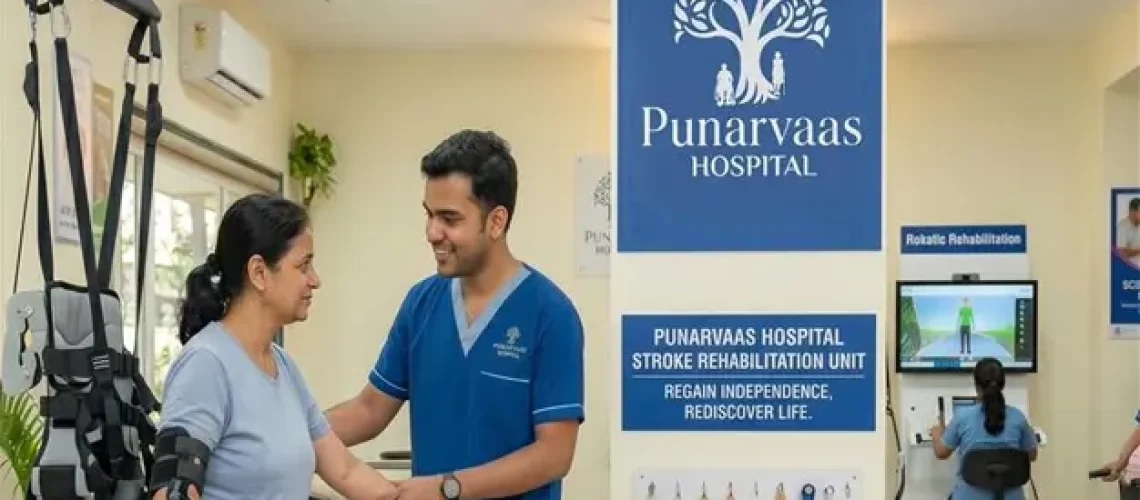
Advanced therapies — when clinically indicated, physiotherapy at Punarvaas is augmented with advanced interventions such as robotics-assisted gait and upper-limb training, Functional Electrical Stimulation (FES), body-weight-supported treadmill training, and virtual-reality-based neurorehabilitation. These technologies amplify the intensity and precision of conventional therapy and are especially valuable for patients with significant motor impairments.
3. Occupational Therapy
Helps patients relearn the Activities of Daily Living (ADLs) — brushing teeth, dressing, eating, bathing, cooking — and adapting to the home environment for safe independence.
4. Speech and Swallowing Therapy
Around 30–40% of stroke survivors develop aphasia or dysphagia. Speech-language pathologists deliver structured therapy to rebuild communication and safe swallowing, which is critical to prevent aspiration pneumonia.
5. Neuro-Cognitive Rehabilitation
Stroke often affects memory, attention, problem-solving, and executive function. Cognitive rehabilitation uses targeted exercises to rebuild these abilities and support a safe return to work and daily life.
6. Psychological Support
Up to 1 in 3 stroke survivors experience post-stroke depression or anxiety. Counselling and psychological care are essential — not optional — pillars of recovery.
7. Caregiver Training
In India, family caregivers play a central role in stroke recovery. Structured caregiver training in transfers, positioning, feeding, and exercises improves outcomes and reduces hospital readmissions.
What Determines Recovery? Key Factors
- Time to rehabilitation — earlier is always better
- Severity and location of the stroke
- Age and pre-stroke health of the patient
- Intensity and consistency of therapy
- Family support and home environment
- Control of risk factors — hypertension, diabetes, cholesterol, atrial fibrillation
How Punarvaas Hospital Approaches Stroke Rehabilitation
Punarvaas Hospital, Bangalore is a dedicated rehabilitation hospital — not a general hospital that offers rehabilitation as an add-on. Our stroke recovery program is built on three principles:
- Physiatry-led, multidisciplinary care — physiatrists, physiotherapists, occupational therapists, speech-language pathologists, rehabilitation nurses, psychologists, and dietitians working as a single team.
- Goal-oriented, measurable progress — assessments using validated tools such as the Modified Rankin Scale, Barthel Index, and Functional Independence Measure (FIM).
- Family at the centre — structured caregiver training, home setup guidance, and continued tele-rehabilitation support after discharge.
Our care philosophy is to balance advanced rehabilitation expertise with cost-effective care, so that families across every section of society can access world-class stroke recovery support.
Frequently Asked Questions (FAQ)
How long does stroke rehabilitation take in India?
What is the difference between OPD and inpatient stroke rehabilitation?
OPD-based rehab is for medically stable patients and typically runs 6–8 weeks of intensive therapy followed by tele-rehab or home-rehab. Inpatient rehab is for patients with severe impairments who need round-the-clock medical care and intensive multidisciplinary therapy.
Does health insurance cover stroke rehabilitation?
Can a stroke patient walk again?
What are the core aspects of stroke rehabilitation?
Physiatry/rehabilitation medicine, physiotherapy (including advanced therapies such as robotics and FES), occupational therapy, speech and swallowing therapy, neuro-cognitive rehabilitation, psychological support, and caregiver training — all delivered by a coordinated multidisciplinary team.
Where can I find the best stroke rehabilitation center in Bangalore?
Punarvaas Hospital, Bangalore is a dedicated rehabilitation facility offering specialized, multidisciplinary stroke recovery programs for hemiplegia, aphasia, dysphagia, and cognitive rehabilitation, balancing advanced care with cost-effective treatment plans.
